
Padel is fast, dynamic and highly addictive.
It is also more physically demanding than many players expect.
Quick changes of direction, repeated rotation, sudden stops, overhead shots and explosive movement place significant demands on the body. Over time, these repetitive patterns can expose weaknesses, imbalances and mobility restrictions.
For players who want to stay on court and continue improving, strength alone is not enough.
The body needs mobility, stability, control and efficient movement.
This is where Pilates can play an important role.
Understanding the Demands of Padel
Padel repeatedly challenges the shoulders, elbows, wrists, spine, hips, knees and ankles.
Players rotate through the trunk, reach outside their base of support, change direction at speed and perform the same movement patterns again and again.
When one part of the body is not moving efficiently, another part often has to compensate.
That is why discomfort in one area does not always mean that area is the underlying problem.
A sore shoulder may be influenced by limited thoracic rotation. Knee discomfort may be connected to hip stability or foot mechanics. Lower-back tightness may be the result of insufficient core control.
Pilates provides a way to look at the body as a connected system rather than treating each area independently.
From Injury Back to the Court
With more than 20 years of Pilates teaching experience and a strong understanding of anatomy and movement, AMP founder Melissa Zecha works with the patterns commonly seen in padel players.
Her own background as a competitive go-karter and racer has also given her first-hand insight into the demands of sport, performance and recovery.
Her approach is not simply about returning a player to where they were before an injury.
The aim is to build a better foundation.
Depending on the individual, Pilates can help improve:
* core stability and control
* hip and shoulder mobility
* rotational strength
* balance and coordination
* postural awareness
* movement efficiency
* stability around vulnerable joints
For a player returning from injury, these elements can help rebuild confidence in movement.
For a healthy player, they can help improve resilience and expose weaknesses before they become bigger problems.
Going Beyond Rehabilitation
Pilates is not only useful when something hurts.
It can also be used as part of a broader performance strategy.
Better alignment can make movement more efficient. Improved trunk rotation may support more fluid shots. Greater hip stability can help with changes of direction. Stronger control through the core can improve balance when reaching for difficult balls.
The goal is not to make a padel player move like a Pilates practitioner.
It is to use Pilates to help the player move better for padel.
Built for the Padel Community
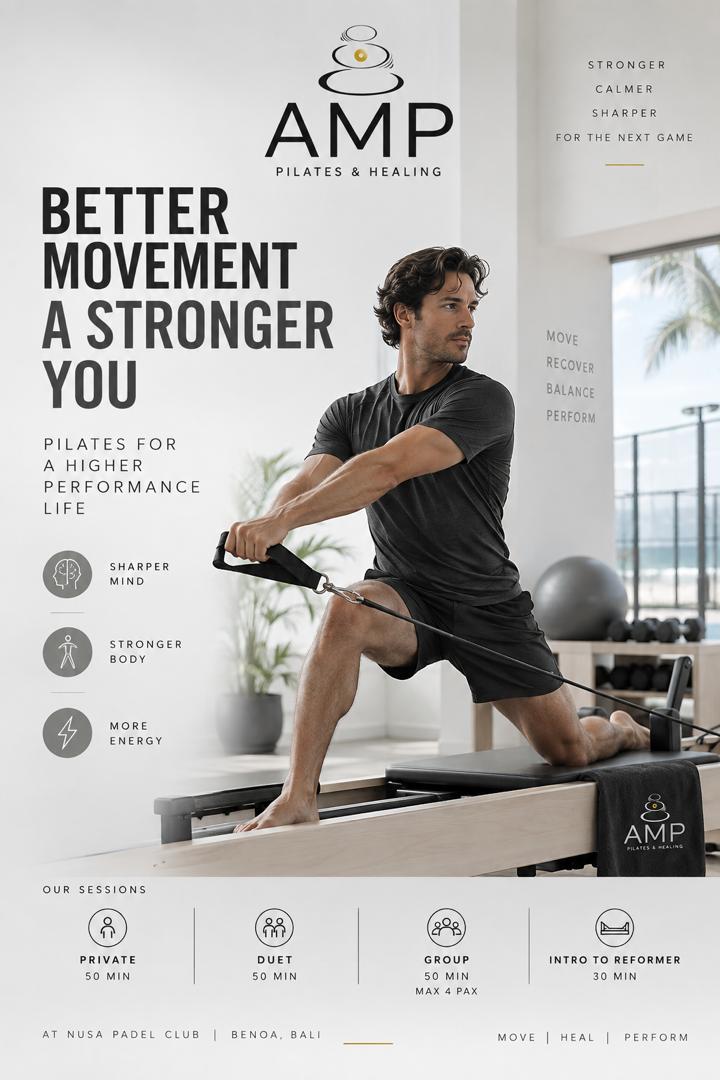
Located within Nusa Padel Club in Benoa, AMP Pilates & Healing has been created with an understanding of the demands placed on active bodies.
Melissa’s combination of Pilates expertise, anatomy knowledge and competitive sporting experience gives her a distinctive perspective when working with players.
Whether the goal is to recover from injury, address recurring discomfort, improve movement quality or take performance to the next level, the starting point is the same:
Understand how the body is moving.
Then build from there.
ALIGN. MOVE. PULSE.
Recover better. Move better. Play better.